AI is everywhere right now — but the conversation around it tends to swing between two extremes: it’s either going to solve everything or it’s completely overhyped. The reality is more interesting and more nuanced than either.
Here’s an honest look at where AI genuinely outperforms humans, and where humans still have the clear advantage.
What AI Does Better Than Humans
Speed and scale:
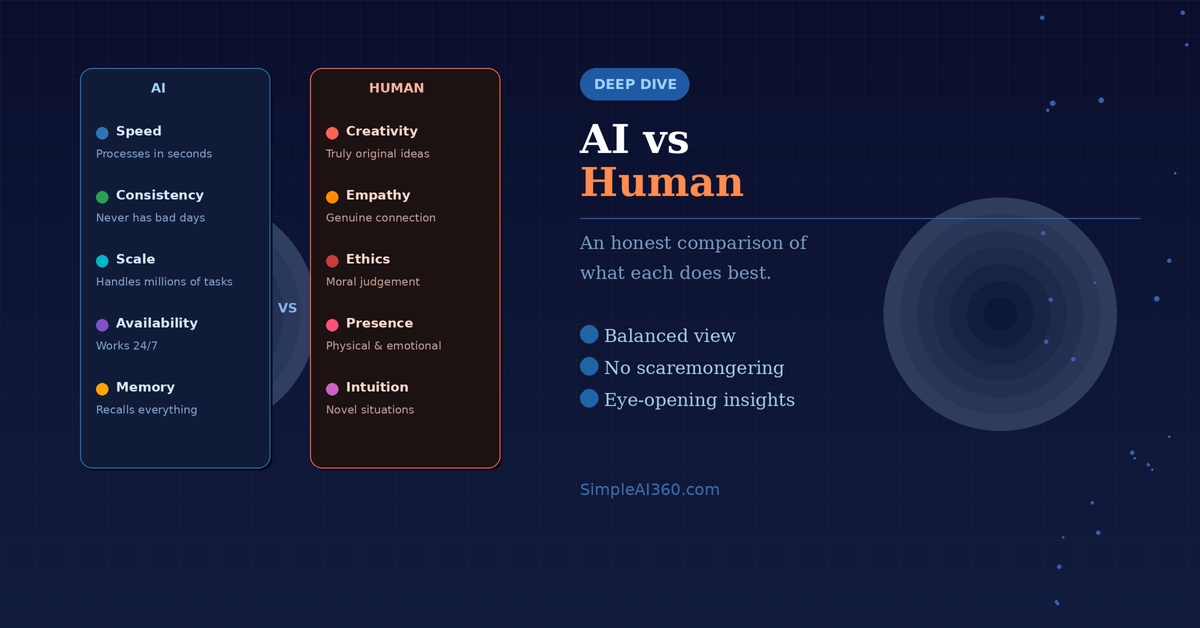
AI can process millions of data points, read thousands of documents, and generate text faster than any human team. Tasks that would take a researcher days can take AI seconds.
Consistency:
AI doesn’t have bad days, doesn’t get tired, and doesn’t let emotions affect the quality of routine work. Ask it to write 100 product descriptions and the 100th will be as good as the first.
Availability:
AI is available 24/7 and never needs a lunch break, holiday, or sick day. For customer service and information retrieval, this is enormously valuable.
Pattern recognition:
AI excels at finding patterns in large datasets — detecting fraud, diagnosing diseases from scans, and predicting equipment failures. These tasks are difficult for humans but straightforward for well-trained AI.
Memory and retrieval:
AI can recall and synthesize vast amounts of information instantly, without forgetting or misremembering.
What Humans Do Better Than AI
Genuine creativity:
AI remixes and recombines existing ideas — it doesn’t truly create something from nothing. The most original human creative work draws on lived experience, emotion, and a perspective that AI simply doesn’t have.
Emotional intelligence:
AI can simulate empathy but doesn’t actually feel it. In situations that require genuine human connection — counselling, leadership, parenting, friendship — humans are irreplaceable.
Ethical judgement:
Deciding what is right in complex, morally ambiguous situations requires human wisdom, cultural understanding, and accountability that AI cannot provide.
Physical interaction:
AI cannot hold someone’s hand, make them a cup of tea, or be physically present. Many of the most important human roles involve exactly this.
Common sense in novel situations:
AI struggles significantly with genuinely new situations it hasn’t encountered in its training. Humans adapt to novelty instinctively.
Where It Gets Complicated
Many tasks sit in a grey area — AI assists but humans lead. Medicine is a good example: AI can analyze scans and suggest diagnoses, but a human doctor builds the relationship, explains the situation, and makes the final call. This human-AI collaboration is where most of the genuine value lies.
Will AI Replace Human Jobs?
Some jobs will change significantly. Repetitive, rules-based tasks are most at risk. But many roles that seemed vulnerable — like creative work, teaching, and management — have proven surprisingly resilient because they require the human qualities AI lacks.
The most common prediction among researchers is that AI will change how most jobs are done, rather than eliminating them entirely. The people who learn to work alongside AI will have a significant advantage.
The Honest Summary
- AI is better at: speed, scale, consistency, pattern recognition, data processing
- Humans are better at: creativity, empathy, ethics, physical presence, novel situations
- Both together: most complex real-world problems
Final Thoughts
Understanding what AI can and can’t do is one of the most valuable things you can know right now. It helps you use AI tools more effectively, protects you from unrealistic expectations, and helps you identify where your unique human skills are most valuable.
The goal isn’t to compete with AI — it’s to work alongside it intelligently.
Enjoyed this guide? Browse more beginner-friendly AI guides at SimpleAI360.com.



Leave a Reply